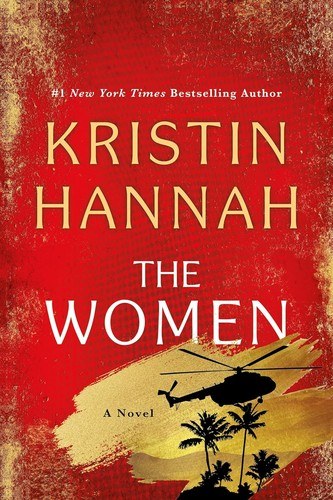
The Women
Short review
Kristin Hannah's The Women was one of the biggest novels of 2024 in hardcover, and its new paperback edition has brought it straight back onto the bestseller lists. Frankie McGrath is a sheltered young woman from Southern California who, in 1965, surprises her family by joining the Army Nurse Corps and shipping out to Vietnam. Nothing in her upbringing has prepared her for the chaos, the casualties and the fierce friendships she finds there.
The second half of the novel follows Frankie home to a country that is deeply divided and largely uninterested in the women who served. Hannah, author of The Nightingale, is at her best with this kind of story: big historical events seen through one woman's courage, grief and resilience. The war chapters are vivid and harrowing, and the homecoming sections are just as powerful in their quieter way. It is an emotional read, so keep tissues nearby, but it is also a moving tribute to a group of veterans whose contribution was long overlooked. Ideal for book clubs.
Sources and retailer details (172 words)
Full review
Kristin Hannah's The Women was one of the biggest novels of 2024 in hardcover, and its new paperback edition has carried it straight back onto the bestseller lists. Frankie McGrath is a sheltered young woman from a comfortable Southern California family who, in 1965, surprises everyone by joining the Army Nurse Corps and shipping out to Vietnam.
Nothing in her upbringing has prepared her for what she finds. Frankie learns her trade in field hospitals under constant pressure, treating terrible injuries and forming fierce friendships with the other women who serve alongside her. Hannah renders these chapters with vivid, often harrowing detail, but also with warmth and humour, capturing how people find ways to keep going in impossible circumstances.
The second half follows Frankie home to an America that is bitterly divided over the war and, to her shock, largely indifferent to the women who served in it. Struggling to be seen and believed, she must find a way to rebuild her life. These quieter sections are every bit as powerful as the battlefield scenes, and they give the novel its lasting emotional punch.
Hannah, author of The Nightingale and The Four Winds, excels at this kind of storytelling: major historical events seen through one woman's courage, grief and resilience. It is a long and emotional read, best approached with tissues close by, and it has clearly struck a chord with readers. For book clubs looking for a story that opens up conversations about memory, service and recognition, it is hard to beat.
Reader review (1)
Reviews from visitors. Checked automatically; names are not shown.
A reader ·
I had read many comments about Kristin Hannah and her novels, but I hadn’t read any yet, so I can’t compare it to her previous work. I have been interested in the Vietnam War and the role the United States played in it for a long time, and I’ve read books (both, fiction and non-fiction), and watched movies, series, and documentaries about it, so this novel seemed a good fit for me. As the description explains, the novel centres on Frankie, a girl from a navy town in California, whose father has never lived up to his disappointment about not having been able to serve his country, and who worships everything military, in particular, navy-related. He is very proud when his son goes to Vietnam. Unfortunately, things don’t go according to plan, and by the time Frankie has decided to enlist as a nurse, tragedy has already fallen on the family. The war is a shock for her, but thanks to two of the veteran nurses (Ethel and Barb) and the patience and understanding of the rest of the staff, she develops into a great nurse, and she ends up signing up for a second tour of duty. She is a religious (Catholic) girl, and pretty conventional and naïve, so she tries to keep men at bay at first, following her strict moral standards, but eventually, she ends up having a relationship with a young man she knew from before, and they make plans for the future. When she returns to the US, she doesn’t get the hero reception she had heard about from WWII. Instead, she is spat on and called names. She had heard of the anti-war movement, but the reality of it hits her hard. That, together with flashbacks and other clear symptoms of PTSD, and a serious loss shortly after her arrival, make her reintroduction into civil life very complicated. Despite the support of her two nurse friends (who’ve both made new lives for themselves), she doesn’t manage to fit in and find her place, and events (and to a certain extent, her own choices and her way of dealing with things, or trying not to deal with them) keep conspiring and take her to breaking point. This novel is a mixture of historical fiction (it captures well the atmosphere of Vietnam, especially the hospitals, although it doesn’t dedicate much space to the Vietnamese people other than in passing), coming-of-age story, and romance/melodrama. In many ways, Frankie is a typical protagonist of a romantic novel: beautiful, naïve, principled, quite green... All the men she meets fall for her, but she sticks to her rules of conduct, at least initially. She falls in between two eras: her mother (and father) expect her to marry somebody of her upper social class, have babies, and have a full social life, taking an interest in some good causes. At the same time, the Hippy movement has arrived, the Civil Rights Movement is in full swing, and so is the Women’s Liberation Movement. Women are demanding more freedom and taking their destiny in their own lives. Frankie doesn’t seem happy in either of these two worlds, and although she tries to get help for her trauma, nobody acknowledges that there were women in the war, and the veteran services and hospitals are only set to look after those who saw action (as if nurses hadn’t seen more than their fair share of it). The story is interesting and it’s difficult to put down once you get into it. On the other hand, I never felt too attached to the protagonist, although I empathised with her and felt quite moved by the way things developed towards the end. I would have liked to get to know more about her two friends, Ethel and Barb. We don’t see or hear things from their perspective, and they are never the focus of the novel, although they represent the support and sisterhood well. The part of their experiences in Vietnam and also what Frankie experiences when she gets back home felt realistic and gripping, but the parts related to her relationships felt overdone and melodramatic. There were many coincidences, many tragic events one after another, and I ended up feeling as if I were watching a soap opera gone to extremes for effect. The other aspect that I thought worked well was the coming-of-age side of things, and how Frankie manages to find a way to become independent and to find a meaningful outlook in life. I would have preferred it if the author had avoided the last twist (this is another case of ‘a twist too far’, in my opinion) but I’m sure readers who like romantic novels will enjoy it. Hannah includes an author’s note, where she explains her interest in the subject and the process of creation of this novel, and a section of acknowledgements which is particularly interesting, as she mentions the people she consulted and recommends some books written by people who survived the experience and others she used as a source, and those will be of interest to people who want to deepen their knowledge of the Vietnam War and the experience of the (western) women who joined the war effort. In sum, this is a book suited to those interested in historical fiction about the Vietnam War, the role of women in that war, and particularly readers who enjoy a good dose of romance and melodrama mixed into their historically inspired novels.