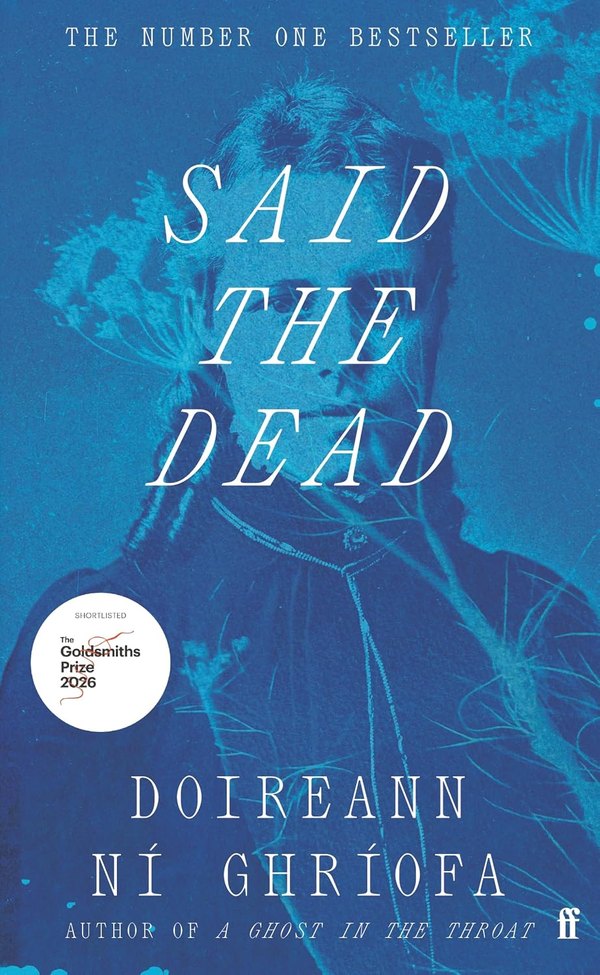
Said the Dead
Published in the United Kingdom
Short review
Doireann Ní Ghríofa, the Irish poet behind A Ghost in the Throat, has followed it with Said the Dead, which is now on both the Waterstones Book of the Year and Foyles Book of the Year shortlists for 2026.
Its subject is the great Victorian asylum in Cork, once the longest building in Ireland. Ní Ghríofa explored the derelict site and then the hospital's casebooks, restricted to records at least a century old, and from them she brings back the lives of women who were committed there, naming them by first name only. Among the staff she finds Lucia Strangman, who arrived in 1896 as the first woman qualified as a psychiatrist in the British Isles.
The book blends research, memoir and imaginative storytelling, with the author sometimes appearing as "the Reader". The Guardian called it extraordinary, resurrecting forgotten patients with imagination and compassion; the Irish Times found it full of interesting stories, and Spectrum Culture this month praised it as a novel of high distinction. It is haunting, humane and formally daring.
Sources and retailer details (173 words)
Full review
Cork's mental hospital, known as Our Lady's, once stretched along the north bank of the River Lee as the longest building in Ireland. Much of it is now apartments. In Said the Dead, Doireann Ní Ghríofa walks its abandoned corridors and then its archives, recovering women whose lives were recorded, and often concluded, within its walls.
As the Guardian's Brian Dillon explains, confidentiality rules meant she could read only records more than a hundred years old, so her voices come from roughly the 1890s to the 1920s. They are vivid: a pregnant woman sent home from America by her brother, a painter who drew a gun on the magistrates trying to commit her, a sixteen-year-old reader of novels who wishes to be dead. Ní Ghríofa uses first names only, a small act of respect that runs through the whole book.
Her counterpart within the story is Lucia Strangman, who joined the hospital in 1896 as the first woman qualified as a psychiatrist in the British Isles, and who appears to have been one of the more humane practitioners of her time. Ní Ghríofa sometimes calls herself the Reader, a figure who listens as closely as Strangman did and who cannot resist imagining what the records leave out.
The form, part history, part memoir and part fiction, will remind readers of A Ghost in the Throat. Critics have embraced it, and it now sits on the Waterstones and Foyles Book of the Year shortlists. Spectrum Culture's recent review called it a novel of high distinction. It is sombre, but deeply compassionate.