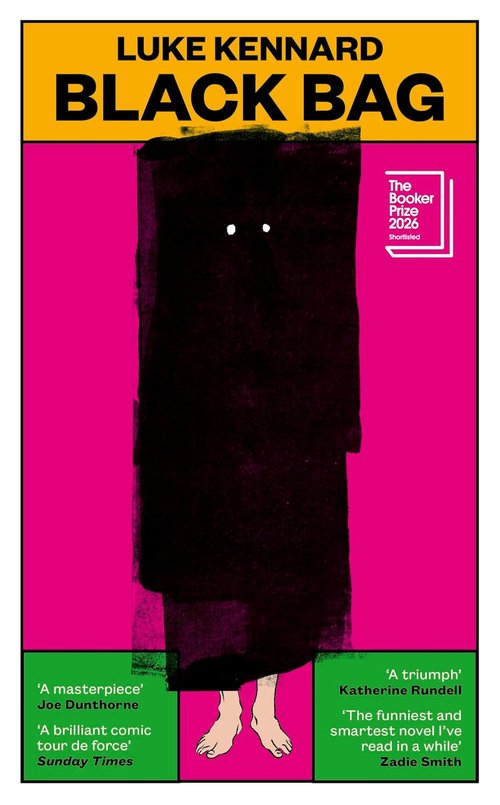
Black Bag
Published in the United Kingdom
Short review
Black Bag was one of six novels on the 2026 Booker Prize shortlist; the prize went to M. John Harrison's The End of Everything on November 9. Luke Kennard's comic novel begins with a gloriously strange job advert: an out-of-work London actor is paid in cash to sit silently at the back of a university lecture theatre for a whole term, wearing nothing but a black leather bag.
The idea comes from a real 1967 experiment at Oregon State University, in which classmates' attitudes towards a bagged student shifted over time. Kennard's narrator throws himself into the role, while his livestreamer friend Claudio spots a business opportunity and a posthumanist professor takes a disconcerting academic interest.
The Guardian called it a campus comedy for our end times, fizzing with wit and invention, and its audiobook review praised Kennard's comic timing. Other critics, including the Michigan Daily, feel it chases too many big questions about masculinity, loneliness and art. Both views are fair: it is a book of brilliant jokes with a melancholy heart about trying to matter.
Sources and retailer details (177 words)
Coverage & sources
- Booker Prize 2026 shortlist (winner announced Nov 9 2026: The End of Everything by M. John Harrison)
- The Guardian (Oct 22 2026): audiobook review, Booker-shortlisted campus comedy
- The Michigan Daily (Oct 27 2026): Booker Prize 2026 review
- The Guardian (Mar 25 2026): review, a campus comedy for our end times
Full review
The premise of Black Bag sounds like a sketch, and Luke Kennard knows it. His unnamed narrator, a London actor in his late thirties surviving on worthy plays and murder-mystery dinner theatre, answers an advert on a site for strange acting jobs. The role: sit at the back of a lecture theatre for an entire university term inside a black leather bag, silent and anonymous, in exchange for cash. For a man who has never landed a part he could play with conviction, it feels like destiny.
Kennard, a poet and novelist, borrows the idea from a real experiment. In 1967 at Oregon State University, a student attended classes fully covered by a bag while researchers observed how classmates reacted over time. Here the fictional experiment's convener insists Bag is to be characterless, and the narrator commits to becoming exactly that. Meanwhile his old friend Claudio, a successful streamer, sees the bag as a brand, and a professor with theories about the coming technocracy takes an unsettling personal interest.
The comedy is sharp and constant, and the Guardian's reviews, of both the book and Kennard's own audiobook narration, single out his timing. Beneath the jokes, though, is a sad and recognisable portrait of millennial creative life: the grotty flat, the visits to parents, the waning hope. Some critics, including the Michigan Daily, find the novel overloaded with themes and the central conceit underexplored.
Shortlisted for the 2026 Booker Prize, which went to M. John Harrison on November 9, it is a sharply funny novel with a tender core.