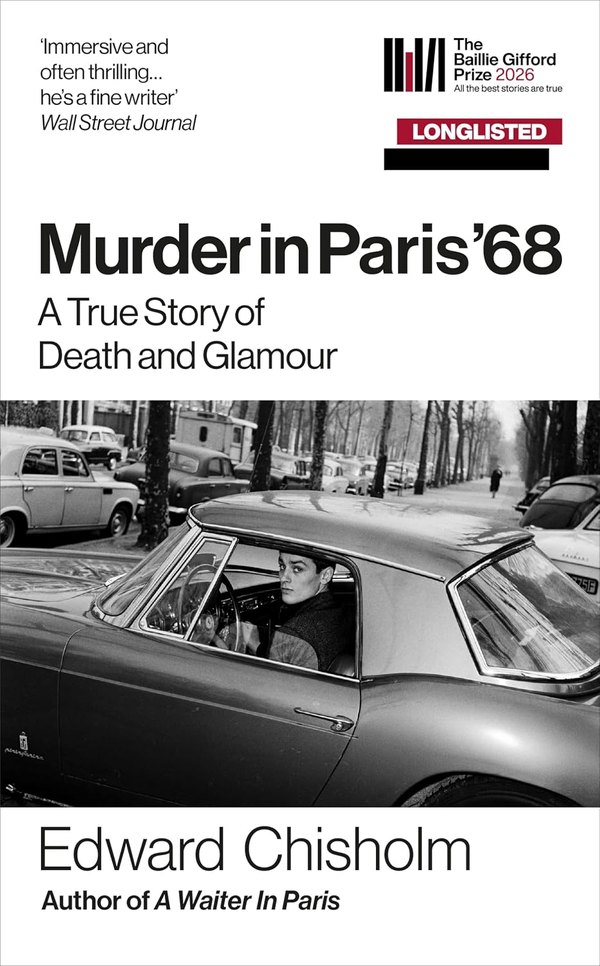
Murder in Paris '68: A True Story of Death and Glamour
Published in the United Kingdom
Short review
In 1968 a body was found in a ditch outside Paris. It was first taken for a vagabond's, until a judge wondered why a petty criminal would have perfectly manicured fingernails. Fingerprints identified Stevan Marković, a Yugoslav hustler and associate of the film star Alain Delon. Edward Chisholm's Murder in Paris '68 reconstructs the scandal that followed.
First published in Britain by Monoray in April and now out in the US from Pegasus Crime, the book was chosen by CrimeReads as one of the best true crime titles of November, and Foreign Policy reviewed it last month. Chisholm traces the tangled bond between Marković and Delon, which ran from friendship to betrayal, and follows the case outward into Paris's underworld, high society and politics.
Readings praised its punchy prose, film-set glamour and film-noir sleaze. Chisholm combines archival research with careful speculation and imagined exchanges, which some readers will relish more than others. The murder remains officially unsolved, so do not expect a final answer. Expect instead a vivid portrait of a city and an era.
Sources and retailer details (175 words)
Full review
The Marković affair is little known outside France, but in its day it reached from a roadside ditch toward the highest circles of French politics. Edward Chisholm's Murder in Paris '68, first published in the UK by Monoray and released in the US this month by Pegasus Crime, makes a gripping case for why it still matters.
Stevan Marković came to France from Yugoslavia in search of opportunity and found it, of a kind, in the orbit of Alain Delon, then one of the most famous faces in cinema. As Foreign Policy's review explains, their relationship is hard to define: they were friends and rivals who betrayed one another repeatedly. Before his death, Marković wrote to his brother that if anything happened to him, Delon would be ten thousand per cent responsible. When his body turned up in 1968, the investigation spread into a web of small-time crooks, socialites, gangsters and political figures.
Chisholm is alert to the uncanny echoes between life and Delon's films. The Australian bookseller Readings points to Purple Noon and Le Samouraï, and the London Telegraph gave the book four stars. He also fills gaps in the record with imagined exchanges and speculation, which is clearly signposted but will not suit every reader. Foreign Policy found it compelling while cautioning that the story's grandest implications may be more air than substance.
CrimeReads named it among November's best true crime. The killing has never been solved, and Chisholm does not pretend otherwise. What he offers instead is atmosphere, character and a sharp sense of 1960s France.