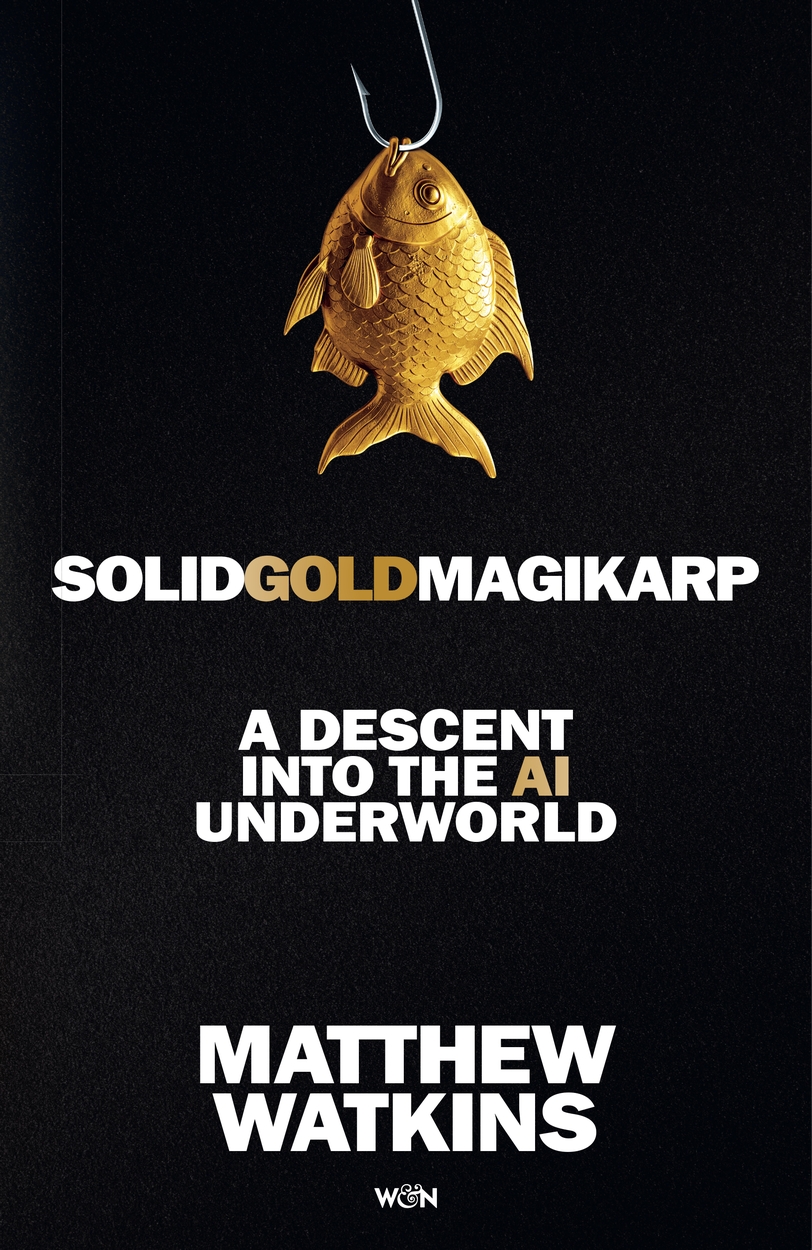
SolidGoldMagikarp: A Descent Into the AI Underworld
Company Pick — reviewed by BooksGoSocial
Published in the United Kingdom
Short review
English mathematician Matthew Watkins went to San Francisco expecting dry technical work on early ChatGPT-era language models. What he found instead were “glitch tokens”: rare strings that could tip GPT-3 into gibberish, hostility or something that looked like paranoia. One of them, SolidGoldMagikarp, gives this memoir its title; another, petertodd, produced dark, adversarial rants that made the system seem briefly unhinged.
Watkins tells that discovery as a gripping, oddball techno-thriller rather than a dry paper. He makes the vocabulary of tokens and large language models digestible, then follows the trail into AI-safety and rationalist circles around the Bay Area, where science, belief and billionaire patronage blur. The New World’s John Dakin praises the surreal cyberpunk energy and the clear explanations, while noting that the glitch eventually looks less like a glimpse of machine consciousness than a side effect of indiscriminate internet training data — impressive, then oddly banal, like catching a Gold Magikarp that is rarer in reputation than in practice.
Blurbs from Alex Bellos and Erik Davis on the Weidenfeld & Nicolson page underline the same strengths: lucid exposition, reportage from the alignment scene, and a dry Gen X eye on the culture shaping how we imagine AI’s future. For readers tired of hype yet curious about what those weird tokens actually were, this is a vivid, sceptical descent into a brief window that has since been patched.
Sources and retailer details (227 words)
Full review
When Matthew Watkins and Jessica Rumbelow jointly found “glitch tokens” in GPT-3 in December 2022, a handful of rare strings could send the model into anomalous behaviour. SolidGoldMagikarp — named for a deceptively prized Pokémon — became shorthand for that strangeness; petertodd pushed outputs into hostile, apocalyptic language. Watkins’s book follows the hunt for what those tokens meant: bug, breadcrumb or fleeting view into how the model “thinks”.
The narrative moves from Berkeley research settings into the wider AI-safety world, where preventing catastrophe sits beside sci-fi jargon, cult followings and money from powerful patrons. Watkins’s earlier Secrets of Creation books prepared him to translate technical material into story; here he leans into thriller pacing without abandoning care about the details. Publisher materials stress the patched window: before the system was fixed, something stranger and more human than expected stared back.
John Dakin’s New World review (October 2026) finds the book fascinating even for AI sceptics, and is sharpest when it lands on the rationalist milieu Watkins moves through — and on the anticlimax that the glamorous glitch may largely be an artefact of messy training data. Praise from Alex Bellos and Erik Davis on the Weidenfeld & Nicolson page echoes that mix of adventure, clarity and cultural observation. The result is less a doom manifesto than a firsthand report from a brief, weird moment in LLM history, useful for anyone who wants the glitch-token story without the hype machine’s volume.