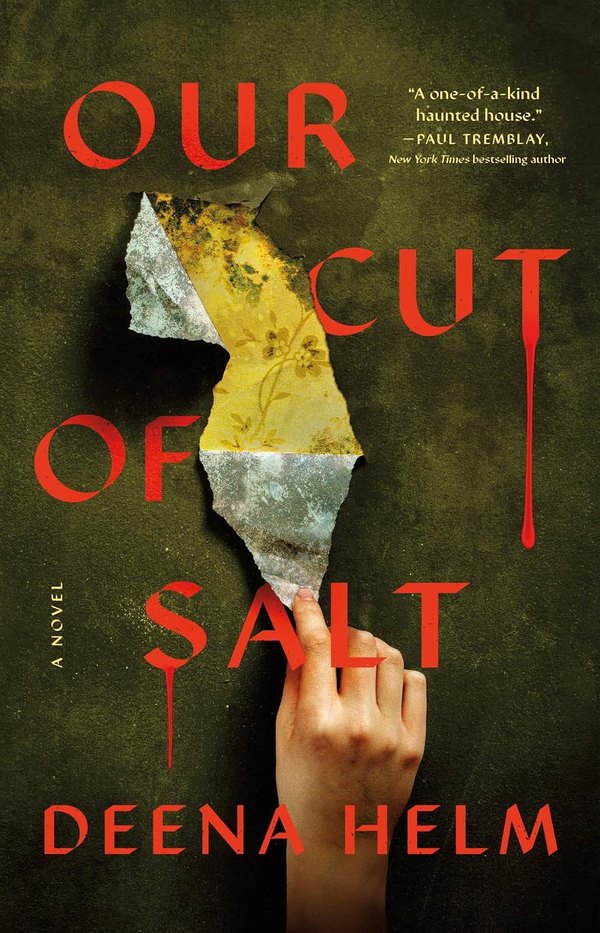
Our Cut of Salt
Suggested by reader Rae
Short review
Deena Helm's debut is a haunted house novel with a difference: the house stands in Haifa, and the haunting is bound up with the Nakba of 1948. Publishers Weekly called it a staggering debut, and Paul Tremblay praised its one-of-a-kind haunted house.
Nuhad never returned to her childhood home after her family fled in 1948, but she never stopped loving it. After her death, her granddaughter Marina, raised knowing little of her heritage, is determined to visit. Marina's mother, Haifa, named for the city the family lost, is frightened of what the trip might uncover. Neighbours warn that the house has a habit of driving people out, yet it seems to welcome Marina, and soon she begins to feel as though she is drowning on dry land.
The story moves between the present and 1948, when sixteen-year-old Nuhad tries to live a normal life in an occupied city, with chilling interjections from the house itself. PW found it lyrical, brutal and devastating. Readers sensitive to depictions of war and violence should take note.
Sources and retailer details (173 words)
Full review
Our Cut of Salt takes one of horror's oldest forms, the haunted house, and anchors it in real history. Deena Helm, a mixed Palestinian-American writer, sets her debut in a house in Haifa that her characters' family left during the Nakba, the mass displacement of Palestinians in 1948.
The narrative runs on two timelines. In the present, Marina has grown up with only fragments of her family's past. When her grandmother Nuhad dies, she resolves to see the home Nuhad never stopped longing for. Her mother, Haifa, named after the lost city, reluctantly lets her go, knowing some secrets are better left buried. In 1948, sixteen-year-old Nuhad tries to keep living an ordinary life as Palestinians are expelled around her.
Helm's house is unforgettable. Cats avoid it, residents have vanished inside it, and neighbours warn that it kicks people out, yet it responds to Marina as if it knows her. Short passages narrated by the house itself, which has been waiting for her, add an eerie and anguished voice. As Marina digs deeper, she becomes ill, struggling to breathe, and Haifa rushes to join her, so that three generations of women converge on the house.
Publishers Weekly called it a staggering, elegant debut, both lyrical and brutal, and said the timelines weave together seamlessly toward a devastating final terror. Tor Nightfire compares it to The Only Good Indians and The Haunting of Hill House. It is grief-soaked and frightening, with a clear message that the worst horrors are human ones. A reader suggestion we are glad to feature.