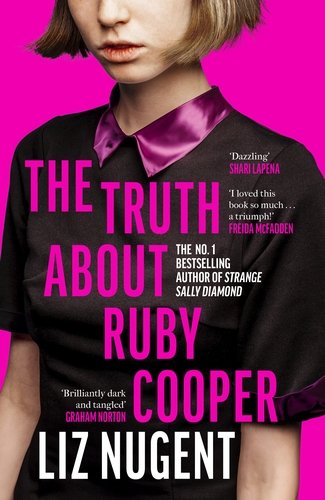
The Truth About Ruby Cooper
Published in Ireland
Short review
Liz Nugent has made a career out of fearless psychological fiction, and her sixth novel may be her most morally complicated yet. It was RTÉ's Book of the Week in April and is shortlisted at the 2026 An Post Irish Book Awards.
Ruby Cooper and her sister, Erin, grow up in a close-knit church community in Boston. When Ruby is sixteen, she is involved in an incident that blows the family apart, and the story follows the fallout across decades and across the Atlantic, with Ruby eventually living in Dublin and Erin remaining in Boston. Ruby would rather not think about the past. The past, of course, has other plans.
Nugent explores how one event can be told in competing ways, and how blame, shame and family loyalty can warp lives for years. Ruby is a difficult, layered character, by turns infuriating and sympathetic, and Nugent never makes it easy to decide what you think of her. The subject matter is dark and some readers will find it uncomfortable. Those who loved Unravelling Oliver or Strange Sally Diamond will find her at the top of her game.
Sources and retailer details (187 words)
Full review
Liz Nugent has a gift for narrators who make readers squirm, and The Truth About Ruby Cooper, published in March by Sandycove, the Irish imprint of Penguin, is one of her most daring books. It was reviewed in The Irish Times crime column, chosen as RTÉ's Book of the Week, and has been shortlisted at the 2026 An Post Irish Book Awards. Nugent's website reports that it went to number one in the Irish charts.
The story begins in Boston, where Ruby Cooper and her sister Erin are raised within a tight church community that values appearances. When Ruby is sixteen, an incident occurs that splits the family and sets off a chain of consequences lasting decades. As adults the sisters live on opposite sides of the Atlantic, Ruby in Dublin and Erin in Boston, but neither can escape what happened.
Nugent is less concerned with a single shocking revelation than with how a family constructs and defends its version of events. She examines rivalry between siblings, the way communities assign guilt, and how a lie can become an inheritance. Ruby herself is complex and often unsettling company; Nugent gives her a voice that is sharp, funny and self-justifying, and refuses to make her simply a victim or a villain.
The novel deals with sexual violence and an accusation that divides a family, and it handles those themes in a way that will provoke debate. Some readers may find it hard going. But the craftsmanship is undeniable, the structure is beautifully controlled, and the final pages land with real force. It is essential reading for fans of dark, character-driven suspense.