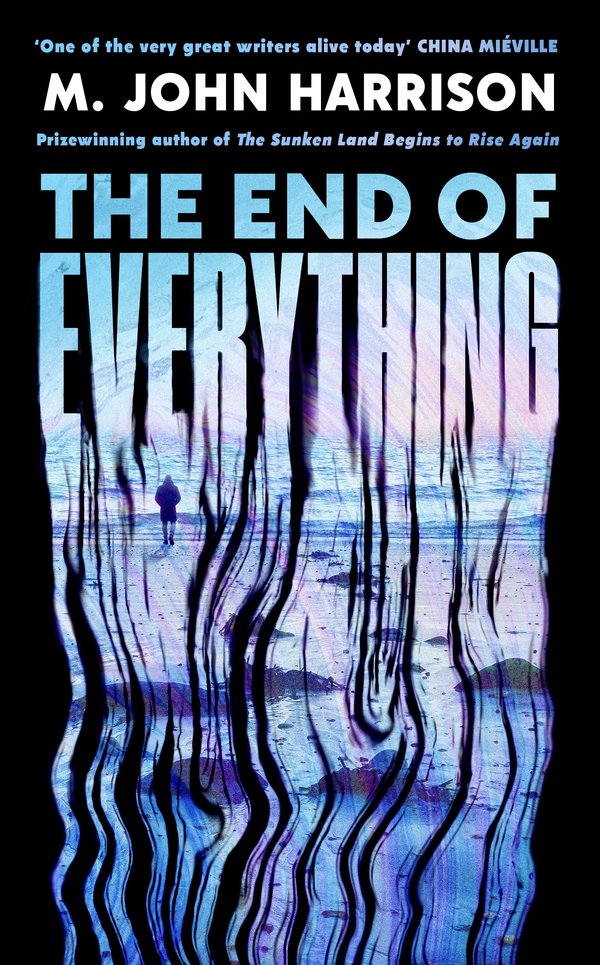
The End of Everything
Published in the United Kingdom
Short review
M. John Harrison has spent more than half a century bending science fiction into strange new shapes, and on November 9 The End of Everything won the 2026 Booker Prize. At 81 he is the oldest winner in the prize's history, and the Guardian reports he is the first science fiction author to take it. It is a near-future novel set on the Kent coast of England, some years after a crisis whose exact nature nobody can quite agree on.
Phillip Tennent scrapes a living as a beachcomber, collecting whatever the Channel washes up. Government barely functions, Europe seems to have been mislaid, the sky glitches and the sea is full of unfamiliar creatures. Then Phillip pulls something from the water that he cannot keep: an object, or creature, that will not stay the same, and which he must carry inland.
This is not a book of tidy explanations. Harrison has long argued that science fiction should embrace the inexplicable, and here he does exactly that, with dreamlike, painterly prose and flashes of dark satire about how people carry on while everything falls apart. Critics have been divided, with some finding it opaque. Readers who enjoy Harrison, Jeff VanderMeer or Christopher Priest will find it mesmerising and unsettling.
Sources and retailer details (208 words)
Coverage & sources
- Booker Prize 2026 winner, announced Nov 9 2026 (The Booker Prizes press release)
- The Guardian (Nov 9 2026): M John Harrison becomes first science fiction author to win the Booker prize
- Reviewed in The Guardian, Jun 9 2026: near-future visions from an SF master
- Booker Prize 2026: winner (previously shortlisted; The Booker Prizes)
- Reviewed in The Irish Times, Jun 20 2026
Full review
At 81, M. John Harrison is one of the elder statesmen of British speculative fiction, and on 9 November The End of Everything won the 2026 Booker Prize, making him the oldest winner in its history. Judging chair Mary Beard called it the politics of now seen through the lens of the future. It is also the first Booker win for its publisher, Serpent's Tail. The novel shows why his admirers prize him and why he can divide readers.
The setting is the coastline of Kent in a near future that has already lived through some kind of catastrophe. No one can explain what happened. The government barely functions, the sea teems with new forms of life, Europe has somehow gone missing and the sky itself seems to malfunction. Phillip Tennent gets by on the tideline, picking up artefacts from the Channel, until he retrieves something that keeps changing and that he cannot simply sell or hide. He has to take it inland.
Harrison is less interested in answers than in atmosphere and perception. His prose is exact and luminous, full of chalky light, damp seaside towns and uneasy encounters, and the reader is invited to dwell in uncertainty rather than solve it. Beneath the strangeness is sharp satire about a society that keeps going about its business while its explanations of the world collapse.
Reviews have ranged from rapturous to sceptical, with The Irish Times finding it rudderless and The Guardian praising its vision. That is a fair guide: if you want a conventional apocalypse with clear stakes, this is not it. If you enjoy fiction that unsettles and lingers, it is a remarkable experience.